Optimizing Laravel Queries: Moving Logic from PHP to the Database
How offloading vegetarian filtering from Eloquent collections to raw SQL reduced memory usage and improved performance in a Laravel menu system
May 1, 2026
Part 2 : Proposal Diet Violations
In part 1, I showed how moving vegetarian checks from Laravel collections into PostgreSQL reduced memory usage and removed unnecessary model hydration. This follow-up applies the same idea to a more realistic screen: a proposal dashboard where each proposal contains multiple services, and each service contains multiple menu items.
The requirement sounds simple:
- show a
Pure Vegbadge when a proposal only contains vegetarian services - show a
Diet Violationbadge when a vegetarian service contains a non-vegetarian menu item
The catch is that this information is not stored directly on the proposals table. It has to be derived through multiple relationships.
Routes
Route::get('/proposals', [ProposalController::class, 'index'])->name('proposals.index');
Route::get('/proposalsv2', [ProposalController::class, 'indexV2'])->name('proposals.index-v2');
Route::get('/proposals/{proposal}', [ProposalController::class, 'show'])->name('proposals.show');
The proposals.index is the application-side version.
The proposals.index-v2 is the database-driven version.
The proposals.show is the detail screen that shows exactly which service is violating the vegetarian rule.
Data Shape
Proposal
├── client()
├── venue()
└── proposalServices()
    ├── is_vegetarian
    ├── servicePeriod()
    └── menuItems()
        └── ingredients()
            └── vegetarian
This is where the cost starts to grow. To answer one badge-level question on the proposal row, the application may end up loading:
- proposals
- proposal services
- menu items
- ingredients
That is a lot of hydrated PHP objects just to answer: “Does this proposal have any vegetarian service with a non-vegetarian ingredient?”
Version 1: Calculate in Laravel
The /proposals route uses eager loading and computes violations in PHP:
public function index(Request $request): View
{
    $paginate = $request->boolean('paginate');

    $proposals = Proposal::with([
        'client',
        'venue',
        'proposalServices.menuItems.ingredients',
    ])->withCount([
        'proposalServices',
        'proposalServices as non_vegetarian_services_count' => static fn ($q) => $q->where('is_vegetarian', false),
    ])->latest();

    $proposals = $paginate ? $proposals->paginate(15) : $proposals->get();

    $proposalCollection = $paginate ? $proposals->getCollection() : $proposals;

    $proposalCollection->each(static function (Proposal $proposal): void {
        $proposal->setAttribute('diet_violation_count', $proposal->calculateDietViolationCount());
    });

    return view('proposals.index', compact('proposals', 'paginate'));
}
And the actual calculation happens on the model:
public function calculateDietViolationCount(): int
{
    return $this->proposalServices
        ->filter(function (ProposalService $proposalService): bool {
            if (! $proposalService->is_vegetarian) {
                return false;
            }

            return $proposalService->menuItems->contains(function (MenuItem $menuItem): bool {
                return $menuItem->ingredients->contains(function (Ingredient $ingredient): bool {
                    return ! $ingredient->vegetarian;
                });
            });
        })
        ->count();
}
This works, and it is easy to read. But it has a clear performance cost:
- Laravel has to hydrate the full nested graph
- every proposal row is processed in PHP
- every service loops through menu items
- every menu item loops through ingredients
In other words, the code is doing set-based work one object at a time.
Why This Gets Expensive
Assume a page loads:
- 30 proposals
- 4 services per proposal
- 8 menu items per service
- 6 ingredients per menu item
That is already:
- 30 proposal models
- 120 proposal service models
- 960 menu item relations
- 5,760 ingredient relations
And all of that is loaded into PHP memory just to decide whether to show one red badge!
Version 2: Offload the Work to PostgreSQL
The /proposalsv2 route pushes the diet violation calculation into SQL:
public function indexV2(Request $request): View
{
    $paginate = $request->boolean('paginate');

    $proposals = Proposal::withClientAndVenueDetails()
        ->withDietViolations()
        ->withCount([
            'proposalServices',
            'proposalServices as non_vegetarian_services_count' => static fn ($q) => $q->where('is_vegetarian', false),
        ])
        ->latest();

    $proposals = $paginate ? $proposals->paginate(15) : $proposals->get();

    return view('proposals.indexv2', compact('proposals', 'paginate'));
}
The important part is the scope:
public function scopeWithDietViolations($query)
{
    return $query->addSelect([
        DB::raw('(
            SELECT
                COUNT(DISTINCT service_period_id)
            FROM
                proposal_services ps
                JOIN menu_item_proposal_service mips ON mips.proposal_service_id = ps.id
                JOIN ingredient_menu_item imi ON mips.menu_item_id = imi.menu_item_id
                JOIN ingredients i ON i.id = imi.ingredient_id
            WHERE
                ps.proposal_id = proposals.id
                AND ps.is_vegetarian = TRUE
                AND i.vegetarian = FALSE
        ) as diet_violation_count'),
    ]);
}
Now the question is answered by the database before the row even reaches Laravel.
Instead of saying:
“Load everything, then inspect each relationship in PHP.”
we say:
“Database, tell me how many violating vegetarian services this proposal has.”
That is exactly the kind of work relational databases are good at.
What Changed in the View
Almost nothing.
Both proposal list views render the same badge:
@if ($proposal->diet_violation_count)
    <span class="inline-flex items-center gap-1 rounded-full bg-red-50 px-2 py-0.5 text-xs font-semibold text-red-700">
        Diet Violation
    </span>
@endif
That is the main benefit of pushing derived values into the query layer: the Blade template stays simple.
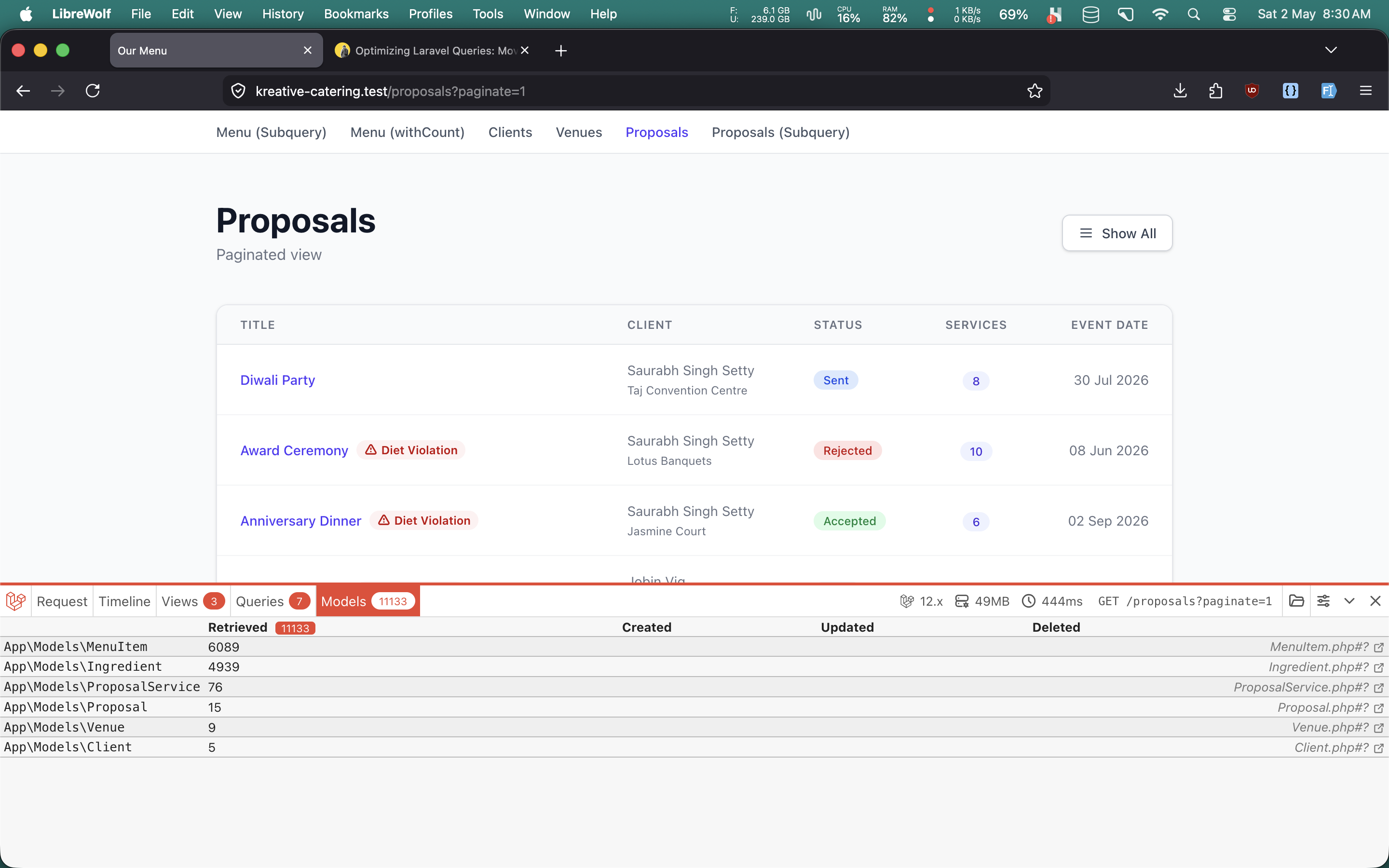
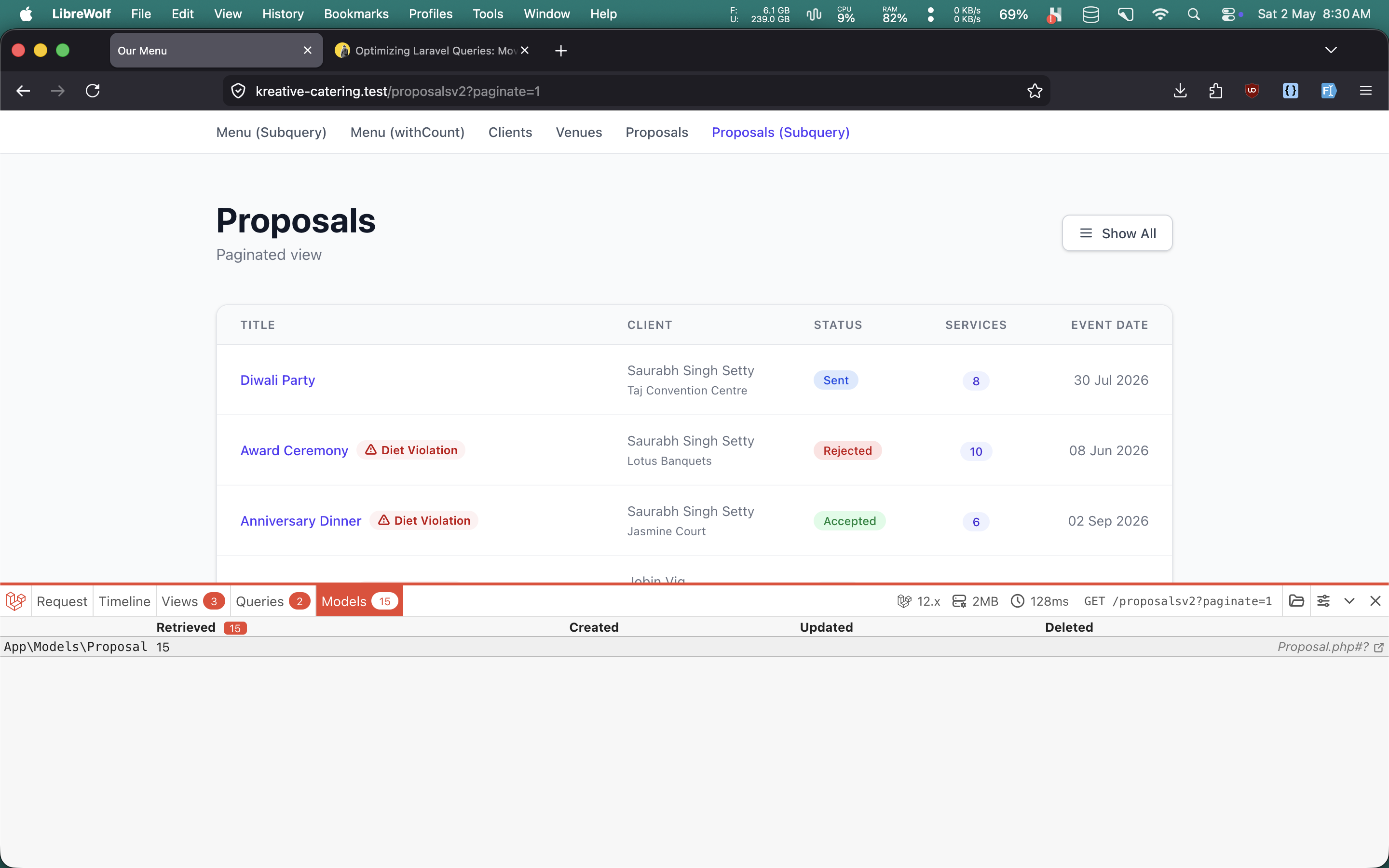
Before / After
What Performance Improvement Did We Get?
The exact answer depends on your dataset, because the benefit scales with relationship fan-out:
- how many proposals are on the page
- how many services each proposal has
- how many menu items each service has
- how many ingredients each menu item has
In part 1, the simpler menu example already saved roughly 10MB of memory. This proposal example has a much deeper relationship graph, so the gain can be even more noticeable on larger datasets.
The safest way to present the result in the blog is:
The database-driven version removes the need to hydrate proposalServices, menuItems, and ingredients just to compute a badge. On large proposal lists, that reduces PHP memory pressure and shifts the heavy filtering work to PostgreSQL, where set-based operations are much faster.Lets measure performance improvements
- response time
- peak memory
- query count
- Model count
For example:
Before  (/proposals):  500ms | 50 mb | 7 query, 11k models !
After   (/proposalsv2): 128ms | 2mb | 2 query, 15 models (Proposal)
Here proposalsv2 we are loading only the Porposal model, and the db takes care of loading the ingredients which is much more performance improvemetns.
Why /proposals/{proposal} Still Matters
The list page only tells us that a proposal has a problem. It does not tell us which service is causing it.
That is why the detail route exists:
Route::get('/proposals/{proposal}', [ProposalController::class, 'show'])->name('proposals.show');Its job is different from the list page. Instead of calculating a proposal-level count, it calculates a service-level boolean:
public function show($proposal): View
{
    $proposal = Proposal::withClientAndVenueDetails()
        ->with([
            'proposalServices.servicePeriod',
            'proposalServices' => static fn ($q) => $q->withDietViolation()->withCount('menuItems'),
        ])
        ->find($proposal);

    return view('proposals.show', compact('proposal'));
}
The withDietViolation() scope on ProposalService adds a has_diet_violation field:
public function scopeWithDietViolation(Builder $query): void
{
    $query
        ->leftJoinSub(
            DB::table('proposal_services as ps_sub')
                ->select(
                    'ps_sub.id as proposal_service_id',
                    DB::raw('
        (
            ps_sub.is_vegetarian
            AND EXISTS (
                SELECT 1
                FROM menu_item_proposal_service
                JOIN ingredient_menu_item ON menu_item_proposal_service.menu_item_id = ingredient_menu_item.menu_item_id
                JOIN ingredients ON ingredients.id = ingredient_menu_item.ingredient_id
                WHERE menu_item_proposal_service.proposal_service_id = ps_sub.id
                AND ingredients.vegetarian = FALSE
            )
        ) AS has_diet_violation
        ')
                ),
            'diet_check',
            'diet_check.proposal_service_id',
            '=',
            'proposal_services.id'
        )
        ->select('proposal_services.*', 'diet_check.has_diet_violation');
}
This route is useful because it answers a different question:
/proposalsv2asks: “Does this proposal have any bad vegetarian service?”/proposals/{proposal}asks: “Which exact service inside this proposal is violating the rule?”
That boolean is then rendered directly in the service card:
@if ($service->has_diet_violation)
    This service is marked as Pure Veg but contains non-vegetarian items.
@endif
So the overall pattern becomes:
- proposal list: compute a proposal-level summary in SQL
- proposal detail: compute a service-level flag in SQL
- Blade: render only the result
Final Takeaway
The unoptimized route is not wrong. It is simply doing relational work in the wrong layer.
When Laravel loads proposalServices -> menuItems -> ingredients just to compute a badge, the application becomes responsible for work that PostgreSQL can do more efficiently with joins, aggregates, and EXISTS.
That is the core lesson from both parts of this refactor:
- use PHP for orchestration and presentation
- use SQL for filtering, existence checks, counts, and derived flags
Once the data grows, that separation stops being an optimization detail and starts being the difference between a page that scales cleanly and one that slowly turns into a memory-heavy loop.
Play around with the codebase vinayakdev/kreative-catering