Optimizing Laravel Queries: Moving Logic from PHP to the Database
How offloading vegetarian filtering from Eloquent collections to raw SQL reduced memory usage and improved performance in a Laravel menu system
February 21, 2026
Menu Items & Ingredients
Before diving into the complete system architecture, let me begin with its fundamental building blocks: menu items and ingredients. Each ingredient is classified as either vegetarian or non-vegetarian, which forms the basis of our data model. Below is a brief overview of the database schema and the relationships between these entities.
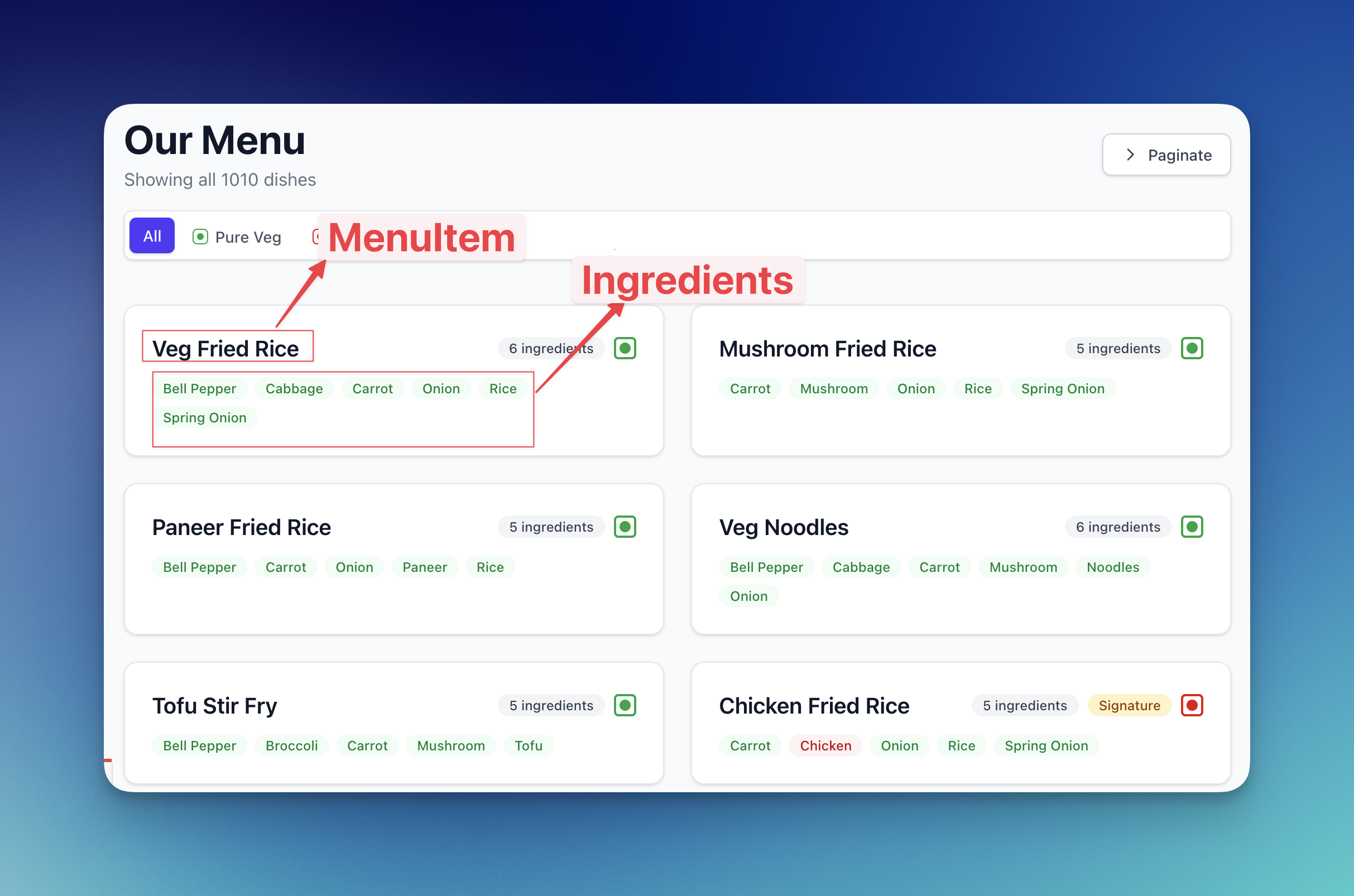
Database Schema
ingredients
├── id                  bigint (PK)
├── name                varchar
├── vegetarian          boolean (default: true)
├── created_at          timestamp
└── updated_at          timestamp

menu_items
├── id                  bigint (PK)
├── name                varchar
├── signature_dish      boolean (default: false)
├── availability        boolean (default: true)
├── created_at          timestamp
└── updated_at          timestamp

ingredient_menu_item
├── ingredient_id
└── menu_item_id
Entity Relationship Tree
MenuItem
├── name
├── signature_dish
├── availability
├── ingredients()           belongsToMany → Ingredient
│   ├── name
│   └── vegetarian
To filter menu items based on their vegetarian status, the most straightforward approach might seem like loading the data from the database and processing it on the server. For a simple project, something like this would work:
<!--$menuItems = MenuItem::with('ingredients')->get();-->

<!--Then in the Blade template, calculate on the fly-->
@foreach ($menuItems as $menuItem)
    @php
        $isVegetarian = $menuItem->ingredients->every(fn ($ingredient) => $ingredient->vegetarian);
    @endphp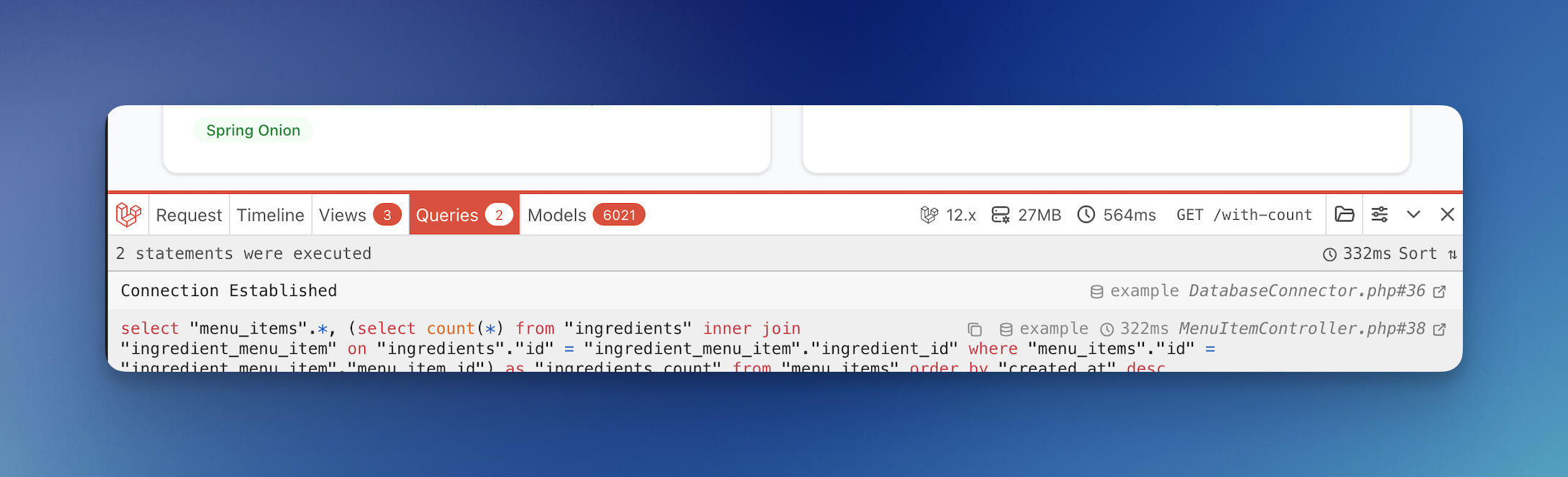
While this gets the job done, it comes at a cost. Every request loads all menu items and their ingredients into memory, only to perform a calculation that the database could handle far more efficiently. When I encountered this pattern in a project I was optimizing, it was contributing to unnecessary RAM consumption and model hydration overhead.
Let’s explore a better approach: offloading this logic to the database itself.
// MenuItem.php

public function scopeWithIngredientsData(Builder $query): void
    {
        $query
            ->leftJoin(
                'ingredient_menu_item',
                 'menu_items.id', '=',
                  'ingredient_menu_item.menu_item_id')
            ->leftJoin('ingredients',
             'ingredients.id', '=',
              'ingredient_menu_item.ingredient_id')
            ->groupBy('menu_items.id')
            ->select(
                'menu_items.*',
                DB::raw('count(ingredients.id) FILTER (WHERE NOT ingredients.vegetarian) = 0 as vegetarian'),
                DB::raw("json_agg(json_build_object('name', ingredients.name, 'vegetarian', ingredients.vegetarian) ORDER BY ingredients.name) FILTER (WHERE ingredients.id IS NOT NULL) as ingredient_list")
            );
    }

protected function casts(): array
    {
        return [
            'vegetarian' => 'boolean',
            'ingredient_list' => 'array',
        ];
    }
A small upfront investment that pays off at scale. DB::raw('count(ingredients.id) FILTER (WHERE NOT ingredients.vegetarian) = 0 as vegetarian'), saving significant memory, reducing query overhead.
<!--$menuItems = MenuItem::withIngredientsData()->get();-->

<!--Just attach the column-->
@foreach ($menuItems as $menuItem)
    @php
        $isVegetarian = $menuItem->vegetarian
    @endphp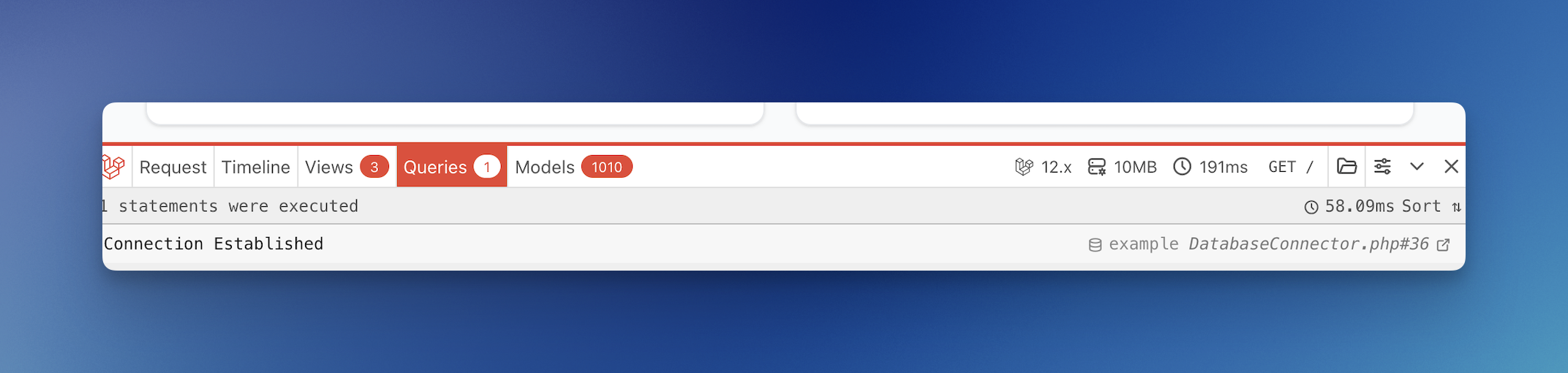
The result? A single query that loads only the models needed for the screen, delivering faster response times and significantly lower RAM usage roughly 10MB saved, which could be reduced even further with pagination.
But this was just the beginning. I'll walk through a more complex scenario that made this database-level approach even more essential. Imagine a Proposal table linked to ProposalService, which in turn contains MenuItem. Now, what if a service has a vegetarian constraint, but an admin accidentally adds a non-vegetarian item to it? Building an overview screen that flags these mismatches — highlighting services meant to be purely vegetarian but containing non-veg items would be a nightmare to handle in application code. I’ll break down how we tackled that in the next post.
Update — A Cleaner Alternative: COALESCE(BOOL_AND(...), true)
After publishing this post, I came across a more expressive way to compute the same vegetarian flag at the database level. Instead of:
count(ingredients.id) FILTER (WHERE NOT ingredients.vegetarian) = 0 as vegetarianYou can write:
COALESCE(BOOL_AND(ingredients.vegetarian), true) AS vegetarianBoth produce the same boolean result, but they work quite differently under the hood. Here’s a breakdown of each.
The original: COUNT ... FILTER = 0
count(ingredients.id) FILTER (WHERE NOT ingredients.vegetarian) = 0 as vegetarianThis counts how many ingredients are not vegetarian. If the count is 0, there are no non-vegetarian ingredients, so the dish is considered vegetarian — the expression returns true. If even one ingredient is non-vegetarian, the count is greater than 0, and the result is false.
It works, but it’s a bit indirect. You’re asking “how many things are wrong?” and checking that the answer is zero, rather than directly asking “are all things correct?“.
One edge case: when a menu item has no ingredients at all, COUNT returns 0, so the expression evaluates to 0 = 0, which is true. In this context that’s probably the right default behaviour — a dish with no ingredients isn’t non-vegetarian.
The alternative: COALESCE(BOOL_AND(...), true)
COALESCE(BOOL_AND(ingredients.vegetarian), true) AS vegetarianBOOL_AND is a PostgreSQL aggregate that returns true if all values in the group are true, and false as soon as any value is false. It’s the SQL equivalent of Laravel’s $collection->every(fn ($i) => $i->vegetarian).
The COALESCE wrapper handles the no-ingredients case. When there are no rows to aggregate, BOOL_AND returns NULL rather than a boolean. COALESCE(NULL, true) replaces that NULL with true, keeping the same default behaviour as the original query — a menu item with no ingredients is treated as vegetarian.
Which should you use?
Both approaches are correct and perform similarly. BOOL_AND reads more naturally — it directly expresses the intent (“are all ingredients vegetarian?”) rather than relying on a count trick. If you’re working in a team or revisiting the query months later, the intent is immediately obvious.
That said, COUNT ... FILTER is widely understood by anyone familiar with SQL and works across more database engines if portability ever matters. BOOL_AND is PostgreSQL-specific.
In the Laravel scope, the swap looks like this:
// Before
DB::raw('count(ingredients.id) FILTER (WHERE NOT ingredients.vegetarian) = 0 as vegetarian'),

// After
DB::raw('COALESCE(BOOL_AND(ingredients.vegetarian), true) AS vegetarian'),
No other changes needed — the cast to 'boolean' in casts() continues to work exactly the same way.